Foresty
Forests as a competitive advantage
Klabin’s forests cover an area of 911,000 hectares, 41% of which is conserved. . The Company has 413,000 hectares of productive areas. Of this total, 58% consists of pine and the remainder eucalyptus. This unique asset base, predominantly made up of pine, provides access to long fiber, which is important for manufacturing stronger products. Its privileged location, with well-distributed rainfall throughout the year and mild temperatures, combined with forest species well adapted to the region and excellence in forest management, enables high productivity and competitive costs.
A year of consolidation for the Forestry Business
The year 2025 consolidated the integration between Klabin and the resources incorporated through the Caetê Project, which involved the acquisition of approximately 150,000 hectares previously owned by Arauco in the state of Paraná. The Company gained a more accurate understanding of how to incorporate the equipment into its routine operations and worked on integrating processes, people, and suppliers, repositioning them within the work plan for the coming years.
In production terms, the ramp-up of Paper Machine 28 and the progress of Paper Machine 27 at the Ortigueira Plant in Paraná established a production level with a new consumption profile and product mix. This required the Forestry area to review wood supply processes across the entire production and logistics chain in order to ensure supply and improve wood quality standards. This was an in-depth and multidisciplinary effort involving the Forestry and mill areas of Planning, Quality, Production, Projects, and Controllership (read more in “Integration between teams and redefinition of parameters”). The pursuit of continuous improvement has also relied on the expertise of the Klabin Technology Center (CTK), which initiated projects to strengthen the interface between Forestry and the mills.
The period was also marked by the search for technologies to support the optimization of forestry production and strengthen employee safety (see “INTEGRA+” and “Safety Master Plan”
Throughout this journey, the Forestry Master Plan, established in 2024, was essential in guiding activities. The year’s main initiatives are listed below.
INTEGRA +
This project seeks to make our forestry operations increasingly efficient, safe and competitive through investments in the adoption of new technologies, employee training, team integration and the development of new processes.
This initiative is focused on modernizing processes, systems and employee training at Klabin as part of its technological transformation.
GlossaryOne of the strategic pillars of INTEGRA+ is the mechanization of Silviculture, an activity strongly impacted by the continuous reduction in the availability of rural labor. With advancements in technology and machinery, it is estimated that more than half of Klabin’s Silviculture operations will be mechanized.
The use of drones also stands out for the application of herbicides and fertilizers, as well as for aerial imaging for multiple purposes, already integrated into operational processes. The adoption of these technologies has led to significant gains: planting has become faster and more precise, costs have been reduced and seedling survival rates have improved.
Safety Master Plan
In 2025, a robust action plan was developed, comprising more than 900 initiatives to be implemented between 2025 and 2027. To support this effort, Klabin conducted an in-depth analysis of all its activities and risks, categorizing them into three operational pillars: Road Safety, Silviculture Safety, and Forestry Operations. Each pillar presents a distinct set of challenges, requiring the development and implementation of tailored solutions.
Among the identified challenges is the active control of road operations, involving more than 4,000 vehicles deployed daily across operations, including trucks, buses, and light vehicles. This includes monitoring deviations related to speed limits, working hours, and routing, among others. A broad initiative, supported by a new 24-hour Security Operations Center, will enable monitoring, control, oversight, and training of nearly 5,000 drivers working daily across operations.
To mitigate these risks, Klabin implemented the following measures:
-
Redefined maximum speed limits across routes, based on assessments of critical segments.
-
Adopted new technology and installed devices and cameras across all vehicles to enable monitoring and control through the new Operational Security Center (OSC), which maintains active communication with drivers throughout their routes.
-
Implemented an alcohol interlock system in the truck fleet. This technology prevents the vehicle from starting if the driver is found to be under the influence of alcohol. Trucks in Santa Catarina are already equipped with the device, and the remaining fleet is expected to be fully implemented throughout 2026.
In the Forestry operational area, an important safety enabler is Superar (Surpass), a continuous improvement methodology. The model adopted in the mills was redesigned to reflect Forestry’s specific context and was implemented in pilot areas in 2024. In 2025, it was expanded to 13 modules, out of a total of 40. Superar encourages employees to adopt autonomous management practices, reinforcing equipment care and strengthening quality and safety standards.
Integration between teams and redefinition of parameters
Integration between Forestry teams, mills, and support areas such as Research and Development and Continuous Improvement is essential to ensure the supply of wood with the appropriate specifications for production, in the required volumes. In 2025, these professionals established joint agendas to discuss solutions to the challenges they faced.
Another good example of multidisciplinary collaboration was the redefinition of supply parameters, such as how long wood can remain in the field before being transported to the mill and the species mix that should be used in production. This review, which directly impacts pulp and paper production, highlighted an opportunity to update the Forestry Business’s transportation structure, initiating the development of a new model.
Forest roads
The roads used for harvesting operations, timber transportation and replanting are prepared by Klabin. To this end, the Company extracts certain materials, such as gravel, lateritic soil and rock, which are used to surface and maintain these roads.
In 2025, Klabin used 508,323 m³ of gravel for road maintenance, surfacing and grading. The Company also provided gravel to municipal governments for use on local roads. Of the material extracted, 86.4% came from Klabin’s own operations and 13.6% from third-party operations.
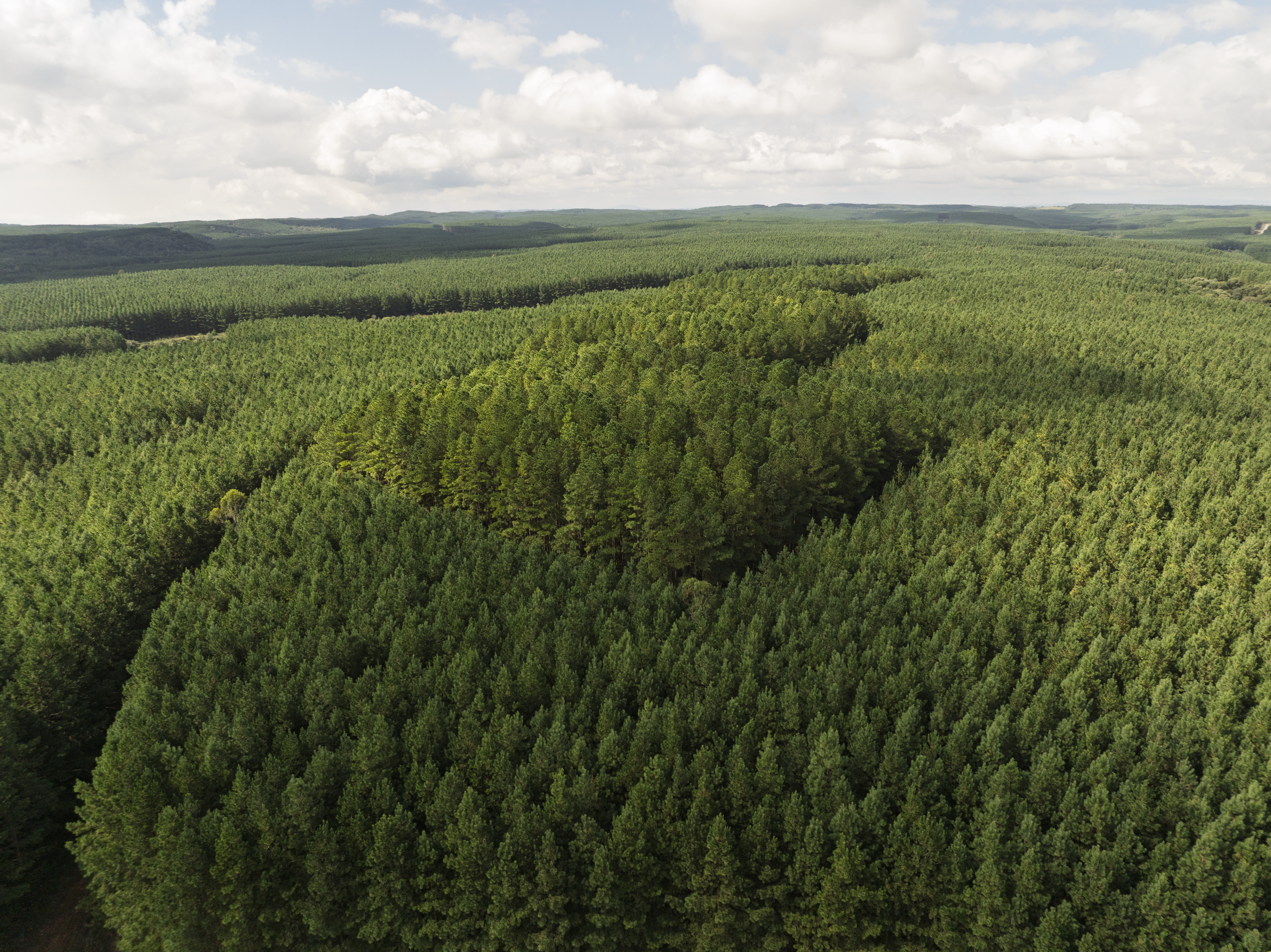
Pine forest in Santa Catarina
Monetization of areas
With the Caetê Project, the Company gained 60,000 hectares of surplus productive land available for monetization. In 2025, as this monetization strategy advanced, Klabin received R$ 2.7 billion in investments through partnerships with TIMOs (Timber Investment Management Organizations).
To execute this asset monetization initiative, the Company established a multidisciplinary team comprising professionals from Commercial, Planning, and Forest Management areas. The team operates under a structured and dedicated agenda for land evaluation and potential market assessment. This approach enables the design of competitive, standalone processes with applicability across multiple economic sectors, creating new negotiation opportunities.
In 2025, as a result of this project, land sales were completed in the third and fourth quarters. This strategy strengthens the Company’s cash position without impacting raw material supply and is expected to continue over the coming years.
Monetização de áreas
Com o Projeto Caetê, em 2025, a Companhia recebeu aportes de R$ 2,7 bilhões a partir de parcerias com TIMOs (Timber Investment Management Organization), passando a contar com 60 mil hectares de terras produtivas excedentes para monetização.
Para a realização desse projeto de monetização de ativos, a empresa formou uma equipe multidisciplinar, com profissionais da área Comercial, de Planejamento e Gestão de Florestas. O time possui agenda estruturada e dedicada para avaliação de terras e mercados potenciais. A partir disso, é possível construir processos competitivos individuais com amplitude para vários setores da economia, abrindo oportunidades de negociação.
Em 2025, a partir desse projeto, foram concretizadas vendas de áreas nos terceiro e quarto trimestres. Essa estratégia fortalece o caixa da empresa sem impacto na produção de matéria-prima e seguirá pelos próximos anos.
Floresta de pínus em Santa Catarina